

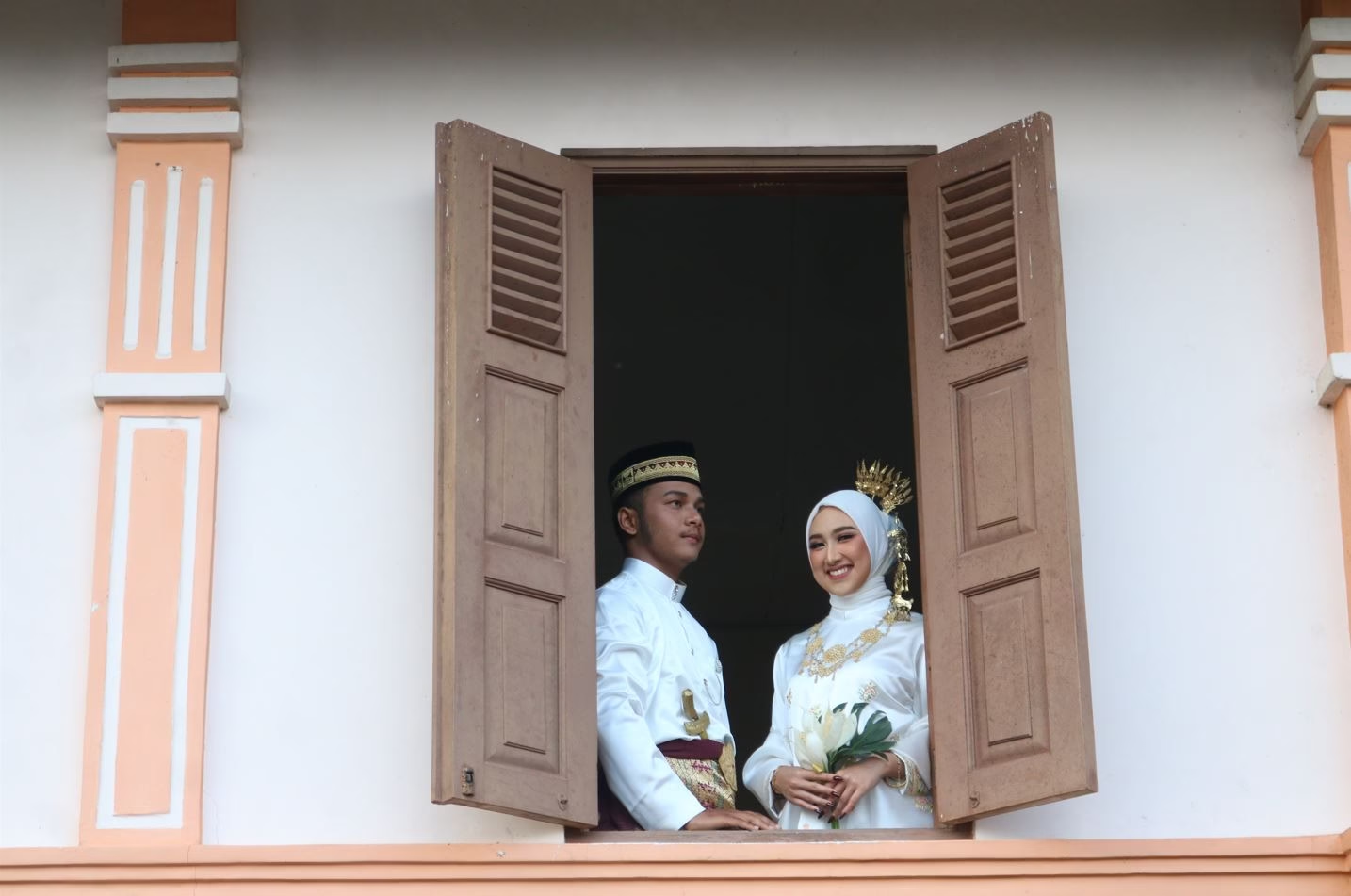
The Minangkabau people of West Sumatra are the world’s largest matrilineal society.
Family lineage is traditionally traced through the mother, ancestral property is connected to the female line, and children belong to their mother’s suku, or clan.
At the same time, Minangkabau society is deeply rooted in Islam.
How, then, does a matrilineal society reconcile its ancestral customs with its Islamic faith?
A well-known Minangkabau principle provides the answer:
Adat basandi syarak, syarak basandi Kitabullah.
In simple terms, it means that adat, or customary law and tradition, is based on Islamic principles, while Islamic principles are grounded in the Quran.
This relationship between adat and Islam can be seen particularly clearly when a marriage breaks down.
Divorce is not simply a matter between two individuals.
It can involve the wider family, maternal relatives, community leaders, religious authorities and, ultimately, the Indonesian legal system.
However, it is important to distinguish between traditional Minangkabau practices and the formal legal process of divorce.
Customary mediation may play an important role in resolving family disputes, but a legal divorce between Muslim couples is handled through the Religious Court (Pengadilan Agama).
When a Minangkabau Marriage Begins to Break Down
Traditionally, marriage in Minangkabau society connects more than just a husband and wife.
It also establishes relationships between their wider families and suku (clan).
For this reason, serious marital problems have traditionally been approached as a family matter rather than something that should immediately be taken to court.
The wife’s maternal relatives, particularly her mamak, can play an important role.
A mamak is a mother’s brother or maternal male relative who traditionally has responsibilities toward his sister’s children and family.
When serious problems arise within a marriage, family elders may become involved in an effort to understand the dispute and find a solution.
The objective is usually reconciliation rather than immediately ending the marriage.
Family Discussion and Rundiang Mamak
One traditional approach involves discussion among the families, sometimes described as rundiang mamak.
The mamak and other family elders listen to the husband and wife, discuss the source of the conflict and attempt to find a solution acceptable to both families.
The exact practice can differ between communities, so it should not be understood as a single formal procedure followed identically throughout Minangkabau society.
Baganyi: When Husband and Wife Separate
If the conflict cannot be resolved immediately, another customary practice that may occur is baganyi.
In this situation, the husband may leave the wife’s family home and return temporarily to his own mother’s or sisters’ home.
This is closely connected to the matrilineal structure of Minangkabau society.
Traditionally, a married man does not permanently become the owner of his wife’s ancestral home.
His connection to his own maternal family remains important throughout his life.
The separation can provide time for both families to consider whether the marriage can still be repaired.
Importantly, baganyi should not be confused with a legal divorce.
A couple can be physically separated while their marriage remains legally intact.
The Role of Ninik Mamak and Tungku Tigo Sajarangan
When a marital dispute becomes more serious, customary leaders may become involved.
Minangkabau communities traditionally recognise the important roles of Ninik Mamak, Alim Ulama and Cadiak Pandai.
Together, these three elements are commonly referred to as Tungku Tigo Sajarangan, or “The Three Elements of the Hearth.”
Each represents a different source of authority within society. Ninik Mamak represents customary and clan leadership.
Alim Ulama represents religious knowledge and Islamic guidance. Cadiak Pandai represents intellectual and practical knowledge.
Their involvement reflects the Minangkabau principle that social life should balance adat, religion and communal wisdom.
In a marital dispute, these figures may help families find a solution before the matter develops into a formal legal dispute.
However, customary mediation should not be presented as a mandatory legal prerequisite for every Minangkabau divorce.
When Divorce Enters the Legal System
If reconciliation fails and the couple decides to end the marriage, the formal divorce process takes place through the Indonesian legal system.
For Muslim couples, divorce is handled by the Pengadilan Agama, or Religious Court. There are two principal forms of divorce.
Cerai Talak
Cerai talak is a divorce initiated by the husband. The husband submits an application to the Religious Court.
If the court grants permission, the husband pronounces the ikrar talak, or divorce declaration, before the court.
Under Indonesian law, a verbal declaration of talak outside the court does not simply replace the formal court process.
The Religious Court system provides the legal framework through which the divorce becomes legally recognised.
Cerai Gugat
Cerai gugat is a divorce lawsuit initiated by the wife.
The wife can bring the case before the Religious Court and present the grounds for divorce.
Indonesian Religious Court guidance distinguishes cerai gugat from cerai talak according to who initiates the proceedings: the wife in cerai gugat and the husband in cerai talak.
The court may also address matters connected to the end of a marriage, including financial obligations toward a wife or children.
Indonesian Religious Court guidance specifically recognises claims relating to post-divorce maintenance and children’s rights.
Once the legal process has been completed, the Religious Court issues the relevant divorce documentation.
What Happens to Property After Divorce?
This is where Minangkabau culture becomes particularly interesting.
The Minangkabau system does not treat every type of property in the same way.
A crucial distinction is between ancestral property belonging to the matrilineal lineage, and property acquired by individuals or a married couple during their lives.
Understanding this distinction is essential to understanding what can happen after divorce.
Harta Pusako Tinggi: Ancestral Property
Harta pusako tinggi is ancestral property inherited through the maternal lineage.
It can include ancestral land, rice fields, houses and other property that has been passed down through generations.
One of the most recognisable examples is the Rumah Gadang, the traditional Minangkabau house associated with the maternal clan.
This property is not simply the private possession of an individual woman.
It is connected to the wider maternal lineage and is traditionally managed for the benefit of the clan.
Consequently, divorce does not normally mean that a husband receives a share of the wife’s harta pusako tinggi simply because he was married to her.
The property remains connected to the wife’s maternal lineage.
This is one of the most important differences between Minangkabau customary property and the way many outsiders might understand marital property.
Harta Pusako Rendah
Another category is harta pusako rendah.
Unlike pusako tinggi, which refers to older ancestral property passed down through generations.
Pusako rendah generally relates to property that comes from a more recent generation or inheritance and may eventually become part of the wider family inheritance system.
The distinction between pusako tinggi and pusako rendah can be complex, particularly when property passes through several generations.
For visitors trying to understand Minangkabau culture, the key point is that not all inherited property is treated in exactly the same way.
Property Acquired During Marriage
Property obtained through the couple’s own work or financial contribution during the marriage is different from ancestral harta pusako.
This can include savings, businesses, houses, vehicles or other assets acquired during the marriage.
Such property can become part of what is legally treated as marital or joint property, and its division can depend on Indonesian law, the circumstances of the marriage and the evidence presented to the court.
It is therefore misleading to assume that every asset is automatically divided 50/50 after a Minangkabau divorce.
The more important distinction is between ancestral property belonging to the maternal lineage and property acquired by the husband and wife during their marriage.
What Happens to the Rumah Gadang?
The Rumah Gadang is perhaps the clearest symbol of the matrilineal system.
Traditionally, it belongs to the maternal family rather than to the husband who marries into the family.
A husband may live in his wife’s family environment during marriage, but his marriage does not transform him into the owner of the wife’s ancestral home.
If the marriage ends, he may leave and return to his own maternal family.
This is one reason why the Minangkabau system can look very different from societies in which a married couple establishes a completely independent household and owns property jointly.
What Happens to the Children?
Minangkabau society traces suku through the mother.
Children therefore belong to their mother’s suku, regardless of the father’s clan.
This does not mean that modern Indonesian legal custody automatically belongs to the mother in every divorce case.
Instead, it is important to distinguish between matrilineal identity and legal custody.
Culturally, children remain part of their mother’s maternal lineage and maintain their connection to her extended family.
Legally, questions concerning custody, support and parental responsibilities can be addressed through the Indonesian court system.
The father also does not simply cease to have responsibilities toward his children after divorce.
Financial and parental obligations can continue after the marriage has ended.
Indonesian Religious Court guidance recognises the importance of protecting the rights of wives and children following divorce.

Life After Divorce
For a Minangkabau man, divorce can also mean returning to the social world of his own maternal family.
Because Minangkabau society is matrilineal, a man’s connection to his mother’s family remains important throughout his life.

He may return to his mother’s or sisters’ household and continue his role within his own maternal clan.
At the same time, divorce does not erase his responsibilities as a father.
For the woman, the end of a marriage also does not mean losing her connection to her family home or maternal clan.
Her relationship with her suku, her relatives and ancestral property continues independently of her marital status.
Divorce at the Intersection of Adat, Islam and Law
Divorce in Minangkabau society cannot be understood through only one system.
There is adat, which shapes family relationships, clan responsibilities and customary approaches to conflict.
There is Islam, which provides the religious framework for marriage and divorce.
And there is Indonesian state law, which determines the formal legal process through the Religious Court.
These systems interact, but they are not identical.
A family may first try to resolve a dispute through relatives and customary leaders.
A husband may temporarily leave the wife’s home during a period of conflict.
Religious figures may become involved in advising the family.
But if the marriage ultimately ends, the legal divorce is handled through the Indonesian court system.
The same distinction applies to property.
Ancestral harta pusako belongs to the maternal lineage and follows customary principles.
While property acquired during marriage can be subject to Indonesian laws governing marital property.
This combination of systems is what makes Minangkabau family life particularly distinctive.
Also Read Mangopi: The Living Coffee Tradition of Minangkabau Society
A Culture Where Marriage Connects More Than Two People
In many societies, divorce is primarily understood as the separation of two individuals.
In Minangkabau society, the picture is broader.
Marriage creates relationships between families and suku, while the matrilineal system means that a person’s relationship with their maternal clan continues regardless of marital status.
When a marriage breaks down, customary family discussions may therefore come before or alongside the formal legal process.
The husband may return to his maternal family. The wife remains connected to her suku.
Ancestral property remains with the maternal lineage. Children retain their mother’s clan identity.
At the same time, Islamic principles and Indonesian law determine the formal legal consequences of divorce.
This intersection of adat, Islam and state law offers a fascinating window into Minangkabau society.
And helps explain why family relationships in West Sumatra cannot always be understood through the same assumptions used elsewhere.
For travellers exploring Minangkabau culture, it is one of the clearest examples of how an ancient social system continues to interact with modern Indonesian life.
